How many megapixels does a large-format print need? Visual acuity, viewing distance and pixel requirements
Short answer: How many pixels a print needs depends on the viewing distance, because the eye resolves an angle, not a length. The common assumption of 60 pixels per degree of visual angle is too low according to a measurement in Nature Communications; there, the mean was 94 pixels per degree. By our calculation, this means around 12 to 29 megapixels per square metre of print from one metre away, and only around 1.3 to 3.2 from three metres.
Planners, print shops, buyers and interior designers are often given a single figure for large formats: so many megapixels, so many ppi, and the print will be sharp. Research on visual acuity shows why such a figure says little without a distance. The eye recognises detail only down to a certain visual angle; how large a detail on the wall may be therefore depends on how close someone stands to it. Behind this article is Gigapixel GmbH — the specialized large-format stock portal: real gigapixel captures from 100 MP, no AI upscaling. We sell high-resolution motifs and therefore state explicitly where the studies draw a line, where a lower resolution is enough and where research has no direct answer. This article sets four studies on visual acuity, display resolution and print quality side by side, calculates the pixel requirement per square metre for different distances and derives how to plan motif, format, viewing distance, material, hygiene and operation.

Visual acuity is an angle: what the eye recognises depends on distance
Since Snellen, visual acuity has been expressed as a visual angle, not as a size in millimetres. In their review of clinical visual acuity measurement, Bailey and Jackson (2016) describe how a person with good normal vision can just recognise letters whose height subtends 5 minutes of arc; the strokes and gaps within these letters each correspond to about 1 minute of arc. In their words: “The angular size of the threshold size optotype was specified by the “Snellen fraction” whose denominator is the viewing distance, and the numerator is the distance at which the height of the letters subtends 5 minutes of arc.”
For planning prints, a second sentence from the same paper matters more. Writing about their charts, the authors state: “if the viewing distance is changed, the threshold size simply moves to different size level on the chart in proportion to the change in viewing distance.” The smallest recognisable detail therefore grows with distance. Someone standing twice as far away needs details twice as large to still recognise them. This is exactly why any statement about the resolution a print needs only makes sense if the distance is given with it.
The eye resolves 94 pixels per degree on average, more than the rule of thumb of 60
Ashraf et al. (2025) measured in Nature Communications that the resolution limit of the eye for fine black-and-white patterns in the centre of the visual field lies on average at 94 pixels per degree of visual angle; the classic visual acuity of one arcminute corresponds to 60 pixels per degree. The measurement involved 18 participants and a display that was moved back and forth on rails. The authors write: “This demonstrates that the 60–65 ppd range is not the “retinal resolution” for a display.” According to Ashraf et al. (2025), individual participants even reached 120 pixels per degree. For red-green patterns the limit was somewhat lower, in their words “89 ppd for red-green vs. 94 ppd for achromatic”.
Two further findings from the same paper are useful for wall surfaces. First, the resolution limit drops quickly outside the centre of gaze; according to Ashraf et al. (2025), for black-and-white patterns it declines by a factor of 2.3 between the centre and 10 degrees away from it. We therefore only see sharply where we are looking, but on a wall the gaze can fall anywhere. Second, the authors also tested the effect of viewing distance and, in their words, “did not observe a consistent trend among our sample of observers”. In their sample, the limit in pixels per degree therefore showed no clear direction when the distance changed.
Lloyd et al. (2015) reach a similar result in a review of nine studies on display resolution for simulators: there, a pixel pitch of 0.5 to 0.93 arcminutes achieved 90% of peak visual performance in observers with normal or better visual acuity. Their conclusion reads: “The common 20/20 = 1 arcmin recommendation is not accurate enough for use as a display system requirement”.
A note on units: pixels per degree (ppd) describe visual acuity, pixels per inch (ppi) the image information in the print and dots per inch (dpi) the way the printer works. The three are not the same. You can only get from pixels per degree to pixels per inch via the viewing distance, and dpi cannot be derived from them at all, because a printer builds each image pixel from many printer dots of its own.
Distance determines the pixel requirement: at one metre, around 12 to 29 megapixels per square metre
By our calculation, a print viewed from one metre needs around 87 ppi with 60 pixels per degree and around 137 ppi with 94 pixels per degree, which is around 12 and 29 megapixels per square metre respectively. The calculation is pure geometry: one degree of visual angle covers a length of 2 · d · tan(0.5°) at distance d, which is around 17.5 millimetres at one metre. Spreading 60 or 94 pixels over that length and converting to an inch of 25.4 millimetres gives the pixel density; its square, applied to one square metre, gives the number of pixels per area.
For other distances, the same calculation gives: at half a metre, around 175 to 274 ppi and 47 to 116 megapixels per square metre; at two metres, around 44 to 68 ppi and 3.0 to 7.3 megapixels per square metre; at three metres, around 29 to 46 ppi and 1.3 to 3.2 megapixels per square metre. The rule behind it is simple: if the distance is halved, the required pixel density doubles and the number of pixels per square metre quadruples.
An example: a wall of three by two metres, that is six square metres, needs around 71 to 174 megapixels at one metre by this calculation, and around 18 to 44 megapixels at two metres. If people come as close as half a metre, the requirement rises to around 284 to 696 megapixels. This is a calculation, not a measured value: nobody has measured on real wall prints at what pixel count viewers see a difference.
Which of the two values applies to a project depends on who looks at the wall and how closely. The lower value describes classic visual acuity, the higher one the measured mean for fine patterns in the centre of the visual field. For a wall where people stop and look for detail, the higher value is the more cautious basis; for a surface that only works from a distance, the lower one is often enough.
From a normal distance fine detail disappears, but not when people step closer
While developing a method for evaluating colour prints, Pedersen and Amirshahi (2010) output a test print at 150 pixels per inch on a wide-format printer and scanned it at several resolutions. The scans with the highest resolution showed more detail than those with lower resolution. The authors note: “However, at a normal viewing distance these details are not apparent in the printed image.” This is a fair counterpoint to the calculation above: from a usual distance, you do not see every fine structure a print contains.
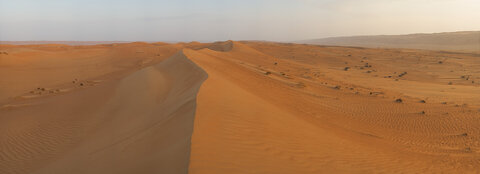
For planning, this is not an all-clear but a distinction. Where a wall is only seen from a distance, such as behind a reception desk or above a staircase, part of the resolution remains unused. Where people step closer, in a foyer, a corridor or a waiting area, this is exactly where high resolution pays off: up close, a motif then shows windows, ornaments, leaves or stones instead of dissolving into a soft surface. In the image above, this is the palace façade, whose decorations only become visible as you approach.
What the four studies measured
The table sets side by side the four studies on which this article is based. Three of them measure or assess visual acuity on charts and displays, one assesses prints; none has studied the pixel requirement of large wall prints.
| Study | Setting / stimulus | Measurement | Finding | Sample |
|---|---|---|---|---|
| Ashraf et al. 2025 | Display on a motorised slider, fine striped patterns in the centre and periphery of the visual field | Resolution limit in pixels per degree of visual angle | On average 94 pixels per degree for black-and-white patterns in the centre of the visual field; 60 to 65 pixels per degree are not retinal resolution | 18 participants |
| Lloyd et al. 2015 | Review of studies on simulator and display resolution | Pixel pitch at which visual performance comes close to its peak | 0.5 to 0.93 arcminutes; the one-arcminute rule is not accurate enough as a requirement | Nine studies, observers with normal or better visual acuity |
| Bailey & Jackson 2016 | Review of clinical visual acuity measurement with letter charts | Visual acuity as the visual angle of the smallest recognisable letter | With good normal vision, letters of 5 minutes of arc and strokes of 1 minute of arc; the threshold shifts in proportion to distance | Review, no sample of its own for this finding |
| Pedersen & Amirshahi 2010 | Test print at 150 pixels per inch on a wide-format printer, scanned at several resolutions | Visual comparison of the scans with the printed image | High-resolution scans show more detail that is not apparent in the print at a normal viewing distance | Not stated (visual inspection as part of method development) |
Source: Ashraf et al. (2025); Lloyd et al. (2015); Bailey & Jackson (2016); Pedersen & Amirshahi (2010).
What the studies do not show
The reviewed literature contains no study that directly measures the pixel requirement of large wall prints. Ashraf et al. (2025) measure on a display in the laboratory, in the centre of the visual field and with high-contrast patterns. Their 18 participants were between 13 and 46 years old, with a mean of 25.5; for an older audience, the mean of 94 pixels per degree is therefore more of an upper assumption. The work reviewed by Lloyd et al. (2015) comes from simulator and display research; the authors themselves write that the requirement depends significantly on luminance, contrast and acuity and is higher for young observers in front of bright, high-contrast displays. Bailey and Jackson (2016) describe how visual acuity is measured on charts, not how sharp an image appears. Transferring all of these values to a print on a wall is our own derivation, not a measurement.
The counterpoint has limits too. Pedersen and Amirshahi (2010) give no distance in centimetres and no number of observers for their visual comparison; their aim was a method for assessing print quality, not a measurement of when viewers recognise detail. The calculation itself assumes that someone with good eyes looks closely from the stated distance; someone who only takes in an impression while walking past sees less. Paper, textile, printing process, light and surface set their own limits. And none of the studies says anything about whether a room with a high-resolution image feels different or whether people feel better there. We therefore do not claim that either.
How to plan a large format by viewing distance: motif, format, distance, material, hygiene and operation
Planning starts with the shortest distance from which the surface is regularly seen in everyday use, because it determines the pixel requirement more than the size of the wall. Motif. In our view, surfaces viewed up close benefit from motifs that reveal something as you approach: architecture with façades and ornaments, forests with individual leaves, mountains with rock and scree. For surfaces that only work from a distance, colour, calm and composition matter more. Landscape and forest motifs for both cases can be found in the category Forest & Nature – Up to 7.6 Gigapixels.
Format and viewing distance. In corridors and on walls next to walkways, people often pass close by; in foyers and meeting rooms, the wall is usually seen from somewhat further away. From the measurement of the resolution limit of the eye by Ashraf et al. (2025), the framework we work with is around 137 ppi at a distance of one metre and 68 ppi at two metres.
We agree with the planner which distance is the shortest regular one in a room; this is our planning assumption, not a study value. Next comes the aspect ratio: wide walls call for a panorama or a crop, and every crop costs pixels. Why images with too few pixels visibly reach their limits in large format is described in our article Why Standard Stock Images Fail in Large-Format Printing.
How to work through the calculation for a specific wall surface including cropping is shown in our article What Image Resolution for a 10m² Wall?
Material, hygiene and operation. Independently of visual acuity, the process maximum in large-format printing is around 240 ppi; this is a figure relating to the printing process, not a study value. The print cannot reproduce more image information per inch than that, even if the file contains it. The calculated value for half a metre, up to around 274 ppi, is already above this; from that close, it is the printing process rather than the eye that limits what reaches the wall. ppi refers to the image information per inch in the print and is not the same as the printer resolution in dpi. In our view, matt, glare-free surfaces are suitable in foyers and corridors so that reflections do not obscure detail. Where people pass by with bags, trolleys or cleaning equipment, robust, wipeable surfaces that tolerate common cleaning agents make sense; in hospitals and practices, the building's hygiene requirements belong in the tender. Fire safety, mounting and material are agreed with the client, the operator and local regulations. In operation, a wall image needs no power and no maintenance like a screen. For later replacement or reprinting, it is worth keeping the original file and the print data.
For planners, print shops, buyers and interior designers, we offer photographed motifs whose pixel count is sufficient even for large formats viewed up close. Every motif is a real capture, not an upscaled image, so that the pixels on the wall show captured detail. We help with the selection by wall size, aspect ratio and shortest viewing distance, and before licensing we state the pixel count the planned format needs according to the calculation above. Print shops receive the original file without an intermediate step. How a motif works in a room depends on light, material and space; we do not promise that, we plan it with you.
Frequently asked questions
How many megapixels does a large-format print need per square metre?
That depends on the shortest viewing distance, not on size alone. By our calculation, one square metre of print needs around 47 to 116 megapixels at half a metre, around 12 to 29 at one metre, around 3.0 to 7.3 at two metres and around 1.3 to 3.2 megapixels at three metres. The lower value in each case applies to 60 pixels per degree of visual angle, the classic visual acuity of one arcminute, the higher one to 94 pixels per degree, the measured mean for fine patterns in the centre of the visual field. For the whole wall, multiply the value by the area in square metres; a wall of six square metres therefore needs around 71 to 174 megapixels at one metre. If cropping is added because the motif has a different aspect ratio from the wall, the original has to bring correspondingly more pixels. This is geometry, not a measurement on wall prints, but it shows the order of magnitude to plan for before a motif is licensed and printed.
Why is the rule of thumb of one arcminute not always enough?
Because many people recognise finer detail than the rule assumes. The rule of thumb comes from clinical visual acuity measurement: someone with good normal vision recognises letters whose strokes subtend about one arcminute of visual angle. That corresponds to 60 pixels per degree. A more recent measurement on displays arrives at a considerably higher mean for fine black-and-white patterns in the centre of the visual field, and a review of studies from simulator research considers the rule not accurate enough as a requirement for a display. For planning, this means: a calculation with one arcminute is rather a lower limit, the higher assumption the more cautious basis. How large the gap between the two is in a given case depends on light, contrast, motif and the eyes of the viewers. A wall in a corridor where younger people also pass close by and stop is therefore better planned with the higher assumption. A wall that only works from a distance can make do with the lower one without anyone noticing a shortcoming.
Can you even see the difference from a normal distance?
Often not, and we say so openly. In a study on evaluating colour prints, high-resolution scans of a test print showed more detail than lower-resolution ones, but at a normal viewing distance this detail was not apparent in the printed image. From a usual distance, the eye therefore does not use every fine structure a print contains. The difference arises when people step closer: anyone who stops in front of a wall in a foyer, passes close by in a corridor or looks into a motif for longer in a waiting area reaches the distance at which fine structures become visible, or are missing. A motif with too few pixels then looks soft, edges become jagged, and featureless areas replace leaves, windows or stones. Whether and how strongly this is noticeable on a particular wall has not been studied by any of the studies in this article. We therefore recommend planning the resolution for the shortest distance people actually take up in everyday use, and not for the distance from which the wall is best photographed.
Which viewing distance matters for planning?
The shortest distance from which the surface is regularly seen in everyday use. In a narrow corridor that can be less than one metre, and the same applies to a wall behind seating. In a tall foyer with a large open space in front of it, on the other hand, a wall is usually seen from several metres. Because, by our calculation, the required pixel density doubles when the distance is halved and the number of pixels per square metre quadruples, this one value decides the order of magnitude of the requirement. A walk-through with the floor plan helps: where do people stand, where do they wait, where do they walk past, where do they stop with a view of the wall? This gives a distance that we agree with the planner. It is a planning assumption, not a study value, and should be stated in the tender so that the print shop and the image supplier calculate with the same figure. For walls seen from different distances, the shorter one counts. Anyone who then chooses a motif whose original has enough pixels of its own for this distance does not have to upscale anything later.
Conclusion
How many megapixels a large-format print needs is decided by the shortest viewing distance. Visual acuity is an angle, and the smallest recognisable detail grows with distance; by our calculation, one square metre of print needs around 12 to 29 megapixels at one metre and only around 1.3 to 3.2 at three metres. The measurements behind this come from eye charts and displays, not from wall prints, and from a normal distance you do not see every detail. High resolution pays off where people step closer: in the foyer, the corridor, the waiting area. This leads to simple planning: set the distance, calculate the requirement, choose a motif with enough pixels of its own, matt, robust and suited to the room. Gigapixel GmbH — the specialized large-format stock portal: real gigapixel captures from 100 MP, no AI upscaling.
Sources
- Ashraf, M., Chapiro, A. & Mantiuk, R. K. (2025): Resolution limit of the eye — how many pixels can we see? Nature Communications.
- Bailey, I. L. & Jackson, A. J. (2016): Changes in the clinical measurement of visual acuity. Journal of Physics: Conference Series.
- Lloyd, C. J., Winterbottom, M., Gaska, J. & Williams, L. (2015): A practical definition of eye-limited display system resolution. SPIE Proceedings.
- Pedersen, M. & Amirshahi, S. A. (2010): Framework for the Evaluation of Color Prints Using Image Quality Metrics. CGIV 2010 Final Program and Proceedings.